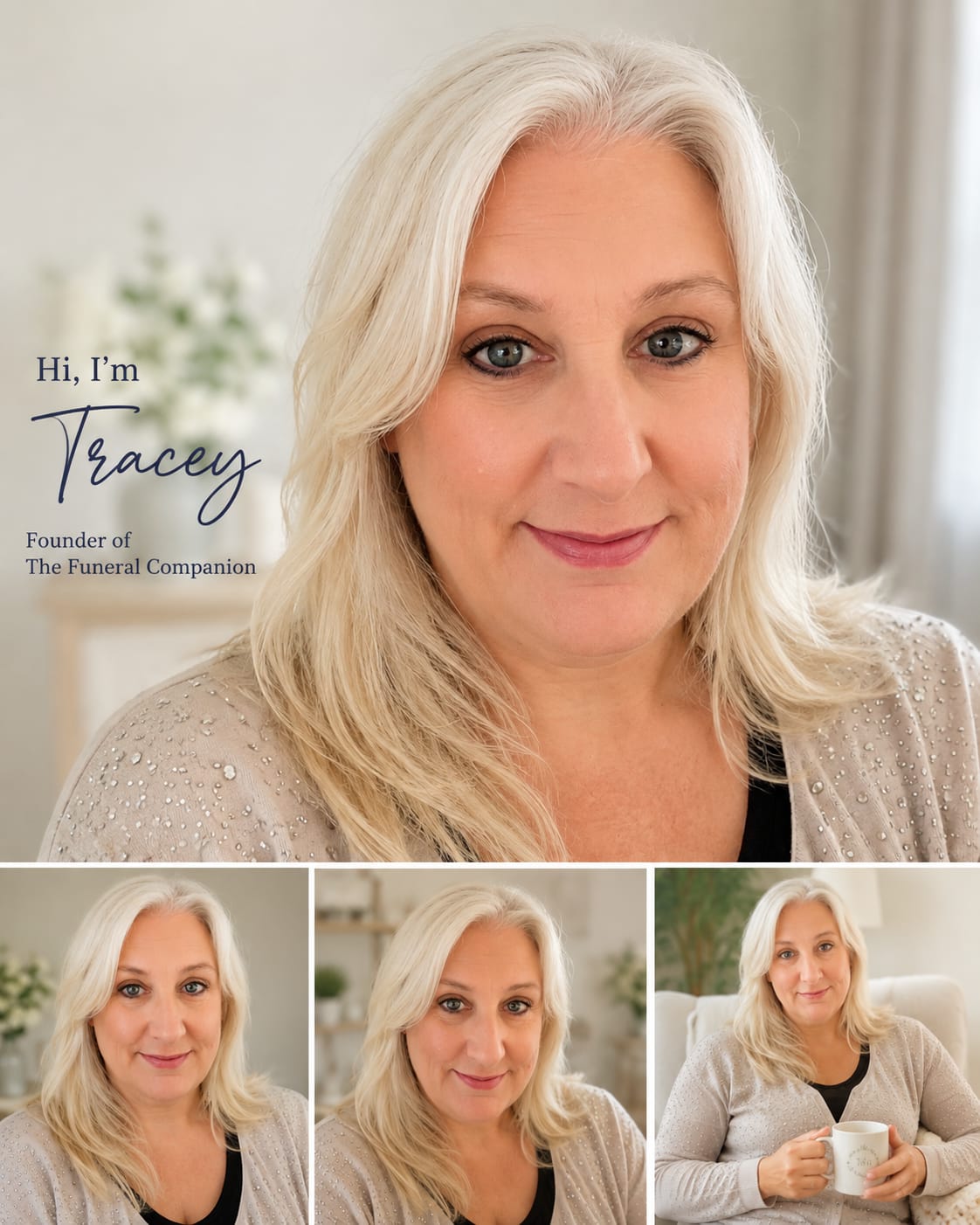
Meet Tracey Anne - The Interview
◆
The aim is to help people get to know the person behind The Funeral Companion, while also learning from your experience.
About you Tell us a little about yourself.
I'm mid fifties, married with 2 adult children, who are both engaged to wonderful people. I’ve been married to Mark for over 30 years and I have been medically retired since 2022. I have really enjoyed and appreciated many things in life, especially my family and my work in funeral care.
How would your friends and family describe you?
They would probably say that I am quiet, well organised, analytical, warm, approachable and friendly.
What do you enjoy doing when you’re not working on The Funeral Companion?
I like to play Sims 4, do adult colouring and reading. I love being with my husband and children, having a big family meal together is my happy place.
Your funeral arranging career
Why did you become a funeral arranger?
I had lost my dad in 2013 and that was the first time I had dealt with a funeral director. I found them to be respectful, empathetic and very kind. I wanted to know more about their work and applied to become a funeral arranger.
What appealed to you most about working in the funeral profession?
That funeral care wasn’t just another job. It was a vocation and helping the bereaved was a privilege and something that really appealed to my empathetic nature.
Can you remember your very first funeral arrangement?
Yes, and although I can’t reveal the details it will forever remain with me. As does every funeral I was privileged to be part of.
What was the biggest challenge when you first started?
To not get emotionally involved with the families. You have to remain professional with respect and empathy at all times.
What did you enjoy most about the role?
Just to be there to support my families and to work with such a great team of people. Every day was different and we also did a lot of charitable work within the local community. Holding coffee mornings and providing food and treats to local care homes and even organising barbecues for them.
What qualities do you think make a good funeral arranger?
Kindness, empathy, patience and to be a good listener. Make a good cup of tea/coffee and be organised.
Supporting bereaved families
What did families need most when they first came to see you?
Support and reassurance and guidance and sometimes just to listen to them.
What was the most rewarding part of helping bereaved families?
The smile and thank you from the family makes it all worthwhile.
How did you help families who felt completely overwhelmed?
Through patience and time. Allowing them to take things at their own pace. Not trying to organise everything in one meeting. Take regular breaks and just by reading the room and taking cues from the family themselves. In a worst case scenario, ending the meeting and rearranging for a time when they feel more able to decide. Often giving them the information to take home to look over and discuss in a more familiar environment in their own time.
Was there a particular conversation that has stayed with you over the years?
Far too many and some even very light hearted or humorous. Not every family were the same. Some were very sombre and heartbroken. Some very matter of fact and some even quiet funny and upbeat. People deal with grief differently so there is no right or wrong way to behave, and certainly no judgement involved.
What do you think people misunderstand about funeral arrangers?
That we are just a receptionist. When infact we are part of the process. Doing the arrangements, the liaising, the bookings, passing on relevant information to the rest of the team involved.
How important is listening compared with talking?
Well firstly, if your talking then your not listening, so you have to know when to be quiet. Ask questions and then wait for an answer. As for the families they can never ask too many questions, or talk too much. We are there to assist and guide them. Even when you are listening to them talking you can quite often get the answers to the questions you haven’t asked yet.
Did families ever teach you anything?
Yes, not to have preconceived ideas as to how a particular arrangement will go. Every arrangement is different.
Behind the scenes
What happens behind the scenes that most people never see?
People quiet often do not realise just how many staff are involved in the funeral process. It is all overseen by the funeral director. He’s like the conductor of an orchestra making sure everyone knows their job and when to do it. The families maybe only ever see the funeral arranger and the funeral director, but they are just the window dressing of a large department store, so to speak. You have the embalmers, dressers, logistics, mortuary staff, drivers, ambulance crew, diary staff and managers in the larger funeral organisations.
How much planning goes into a funeral?
A lot, as well as the other funeral staff you have to liaise with GP’s, coroner’s, celebrants, ministers, cemetery and crematorium staff, florists, memorial item and coffin suppliers, bereavement offices, registrars and so many more.
What surprised you most about working in the profession?
How dedicated everyone is.
Is there anything you wish every family knew before arranging a funeral?
That there is so much you will need to know and think about before arranging a funeral.
What myths about funerals would you like to dispel?
That we reuse coffins or that hair and nails continue to grow after death. Of course the answer to all of that is no. Coffins are ordered to the specific size of the deceased person. And skin tends to shrink after death which gives the impression of hair and nails still growing.
The emotional side Was it difficult leaving work at work?
At times yes, especially after an emotional funeral arrangement.
How did you cope with supporting grieving families every day?
I always felt privileged to be part of their loved ones final journey. If I made the family feel supported and understood during the process that was all that mattered to me.
Did the job change your outlook on life?
It made me look at death differently. I wasn’t scared any more. It became more about those left behind and living your best life. Celebrating the person that had gone.
What did it teach you about love and loss?
That love never really dies and we will always hold our loved ones in our heart and memories.
Did it make you appreciate the little things more?
Absolutely, it makes you appreciate the people in your life and to make sure you always tell them how much you care about them.
The Funeral Companion
What inspired you to create The Funeral Companion?
When someone dies you have to contact so many different people and organisations. You need to make so many decisions and unfortunately it means trawling through so many different websites. I wanted the families to have a central point of information and to also be aware of some of the decisions they will need to make. I wanted to make the funeral industry more transparent and easier to understand.
Why was it important that it was independent?
I had been trained by Co Op Funeralcare and will remain forever grateful to them. I had the best experience there and learnt so much. But, I wanted to give people an all round view of funeral care, not just what the big companies do. I wanted to give people choices, to see that there are always other options around.
Why do you want the information to be free?
It is independent information gathered from several sources that helps people. I don’t believe in charging for that. The people who need this information already have a lot to pay out for so I have chosen to keep it completely free and unbiased. Plus, it a project that comes from the heart and I wanted to help people in their time of grief.
What gap are you hoping to fill?
There are a lot of information websites on funerals, but they all seem to specialise in an area that benefits the website provider. My aim is to bring all those information sites together. Backed up by checklists and guides and clear information.
You have the government website which is a great resource and so many others represented on my site. I do not want to replace any of them but just help to signpost these areas more clearly. Arranging a funeral, who to contact, what you need, understanding who the people in the process are and what they do. All in one place. That’s the gap I want to fill.
What do you hope families feel when they visit the website?
That they can find what they need.
If someone only reads one page on your website, what do you hope they take away?
That is has helped them understand something and that they would feel happy to recommend it to someone else.
Looking ahead Where would you like to see The Funeral Companion in five years?
Still a free resource for anybody that needs it, and that it will become a valuable resource to the funeral industry.
If funding wasn’t a problem, what would you build first?
I would have free handbooks and introduction packs for all care homes, hospices, bereavement centres and citizen advice centres. Leaflets to all funeral directors, church halls and GP surgeries. I would want all the relevant places to have the physical resources to hand out to those in need. Professionally printed and totally free.
What message would you like healthcare professionals and funeral professionals to hear about your project?
To know that there is a now an independent free resource available, operated by people from within the funeral industry who really care and can be trusted.
Quick-fire questions :
Tea or coffee?
Coffee
Sunrise or sunset?
Sunset
Book or film?
Film
Quiet reflection or a busy family gathering?
Quiet reflection
What’s one word that sums up kindness?
Considerate
What’s one piece of advice you try to live by?
Hindsight is always one step behind
Finally... If you could sit with someone who has been bereaved today, what would you say to them?
Just to quietly sit with them and say that I’m here if you want to tell me about them.
When people think of The Funeral Companion in years to come, what do you hope they’ll remember?
That they could get the information they needed and a bit more from a trusted free resource designed by someone who cares.
Thank you.
Back to Homepage