G1 What to do When Someone Has Died
Losing someone is never easy, and knowing what to do next can feel overwhelming. This guide explains the first steps to take after someone dies, helping you understand what needs to be done, when it needs to be done, and where to find further support. We are so sorry for your loss and hope that this website can help you through this difficult time.
Step 1: Obtain a Medical Certificate of Cause of Death
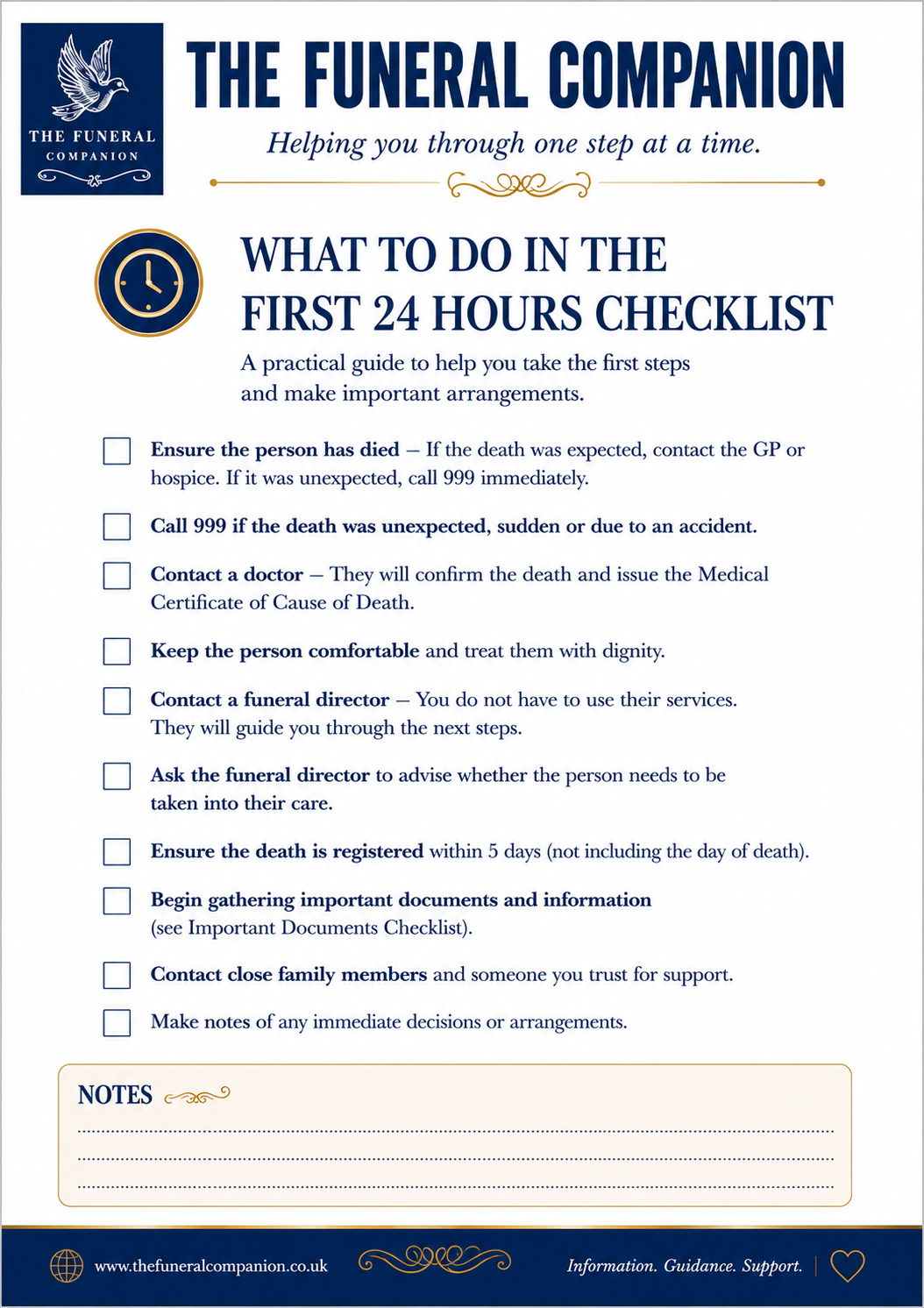
If the person dies in hospital, a doctor will usually issue the Medical Certificate of Cause of Death. If the person dies at home and the death was expected, contact their GP or the NHS service caring for them.
If the death was sudden, unexpected, or unexplained, contact 999 immediately. The police and other authorities may become involved, and the death may be referred to the Coroner.
Step 2: Register the Death
In England and Wales, most deaths should be registered within 5 days, although this can be longer if the Coroner is involved. You will usually need to make an appointment with the local Register Office.
Step 3: Arrange the Funeral
Once the death has been registered, you can begin making funeral arrangements.
You may wish to:
- Choose a funeral director.
- Decide between burial or cremation.
- Select a date and venue.
- Ask about estimated funeral costs.
- Choose music, readings, flowers and personal tributes.
- Consider whether you would like a religious or non-religious service.
Step 4: Tell Family and Friends
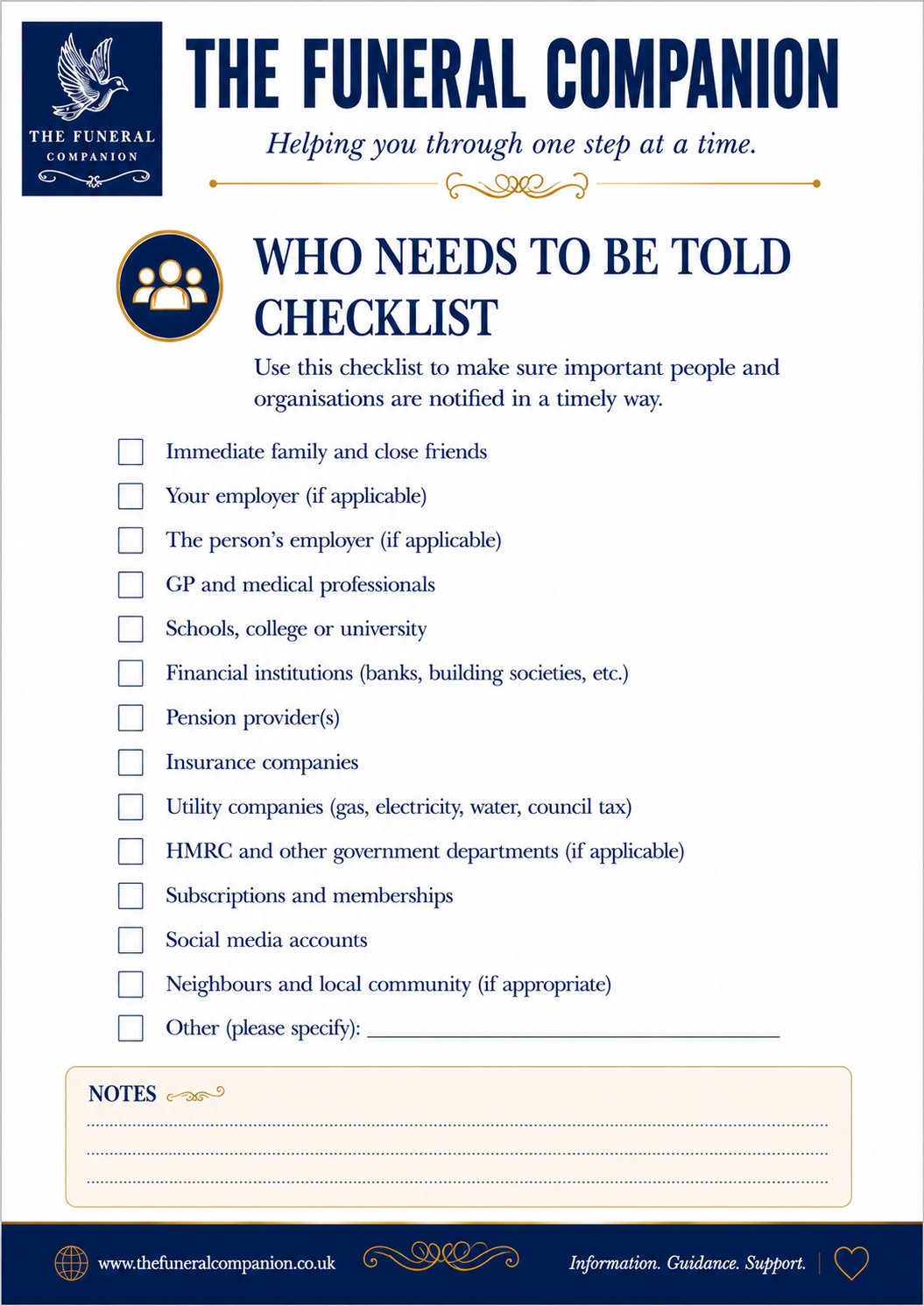
Let close family and friends know what has happened and share funeral arrangements when they have been confirmed.
Step 5: Notify Organisations
You'll need to inform organisations such as:
- Banks and building societies
- Pension providers
- Insurance companies
- Utility providers
- Council Tax https://www.gov.uk/pay-council-tax
- DVLA https://www.gov.uk/government/organisations/driver-and-vehicle-licensing-agency
- HMRC https://www.gov.uk/government/organisations/hm-revenue-customs
- Department for Work and Pensions (DWP) https://www.gov.uk/government/organisations/department-for-work-pensions
- GP Surgery
Many government departments can be notified using the Tell Us Once service, where available. Please see information from their website below:
Before you use Tell Us Once
You’ll need the Tell them the reference number that you got from the registrar. You’ll also need the following details of the person who died:
- surname
- date they died
- name, address and contact details of the person or company dealing with their estate (property, belongings and money), known as their ‘executor’ or ‘administrator’
- if there’s a surviving spouse or civil partner, the name, address, telephone number and the National Insurance number or date of birth of the spouse or civil partner
- if there’s no surviving spouse or civil partner or their spouse or civil partner is not able to deal with their affairs, the name and address of their next of kin
- if they died in a hospital, nursing home, care home or hospice, the name and address of that institution
You may also need:
- if they had a valid British passport, their passport number and town of birth
- if they had a driving licence, their driving licence number
- if they owned any vehicles, the vehicle registration numbers
- if they were paying Council Tax or getting services from their local council, such as Housing Benefit payments, the name of their local council and which services they were getting
- if they had a Blue Badge, their Blue Badge number if you know it
- to know if they were getting any benefits or State Pension
- to know if they were getting money from an Armed Forces Pension or Compensation Scheme
You’ll also need their National Insurance number if they were getting money from or paying into any of the following pension schemes:
- Civil Service Pension Scheme
- Local Government Pension Schemes (LGPS)
- NHS Pensions for NHS staff in England and Wales
- Pension Protection Fund and Financial Assistance Scheme
- Scottish Public Pension Agency schemes for NHS staff, teachers, police and firefighters in Scotland
If they are not in one of these pension schemes, you can still provide their National Insurance number. It will help some organisations match their records faster. You need permission from any surviving spouse or civil partner, the next of kin, executor, administrator or anyone who was claiming joint benefits or entitlements with the person who died, before you give their details.
Step 6: Take Good Care of Yourself
Bereavement affects everyone differently. It's okay to ask for help from family, friends, your GP or bereavement support organisations if you need it. Although you may not feel like it, please remember to eat and drink, if only little amounts.
We have a page on Bereavement Support if you need it please click HERE
Please Remember
You don't have to do everything at once. Take one step at a time, ask for help when you need it, and don't be afraid to lean on family, friends, your funeral director, or bereavement support services.
Grief affects everyone differently. There is no right or wrong way to grieve. Take each day one step at a time, accept help when it is offered, and remember that support is available if you need it.
The Funeral Companion is here to guide and support you every step of the way.
If Someone has died abroad please click HERE for advice on repatriation.